Common Off-ice Training Questions
How many times a week should skaters work off ice to see results (based on ages/levels)?
The amount of time a skater should work out off-ice should be based on their age and level, and is usually specific to their individual goals.
Sometimes a skater who is younger but at a higher level, will need to make sure they take into account proper fitness development pathways and vice versa for an older skater who is at a lower level should not be thrown into a class with elite skaters the same age.
A generalized suggestion based on the LTD would look something like this:
- Age (7-11): Working on single jumps: 1-2 hours per week learning fundamental movements and basic strength, agility, coordination, balance, flexibility, and basic jumps.
- Age (9-13): Working on doubles: 3-5 hours per week. Each session should be approximately one hour in length and should include some type of dance and movement classes for both males and females. Sessions should focus on exercises that utilize body weight, medicine balls, and exercise/stability balls. Stamina also needs to be a focus for both females and males and cardiovascular conditioning sessions should be introduced.
- Age (10-16): Working on doubles and triples: 4-13 hours per week. In addition to warm-up and cool-down periods, athletes’ optimal on-ice activity at this level ranges from four hours (for younger ages) to 13 hours (for older athletes). All off-ice activity should be focused on enhancing on-ice performance. This might include off-ice jump classes, dance, movement and theatre classes, core strength conditioning, flexibility work, cardiovascular enhancement and overall strength training.
- Age(13-19): Elite competitive level: 5 days a week strength & conditioning (does not mean all legs, but each day has a different focus) and up to 15 hours a week off ice including other forms of activity such as dance, flexibility, yoga, pilates, warm up/cool downs all can add to these hours for off-ice. In general, off-ice training needs to have the same commitment as on-ice training and needs to include short, medium and long term goals. Specific work done off-ice must reflect the principles of periodization and take into account the age, growth and development of the athlete. At this level off-ice programs should be very sport-specific and based on the individual needs and fitness test results of the athlete.
Periodization of off-ice to match season goals
Periodization is a way to measure and track what steps you will take throughout the season to achieve a desired result in both fitness and skating. This kind of planning is usually done when a skater enters into a more competitive competition schedule, however it does not mean you can’t introduce aspects of periodized training to the athlete earlier.
When I sit down with a skater, we usually talk about what their season looks like in 4 quarters: (pre-season, in- season, post-season, off-season). From there we talk about what their focus areas are in each part for their on ice goals, and then we can go backwards from there to see what their fitness should look like.
Depending on when the skater has their peak competition, we can decide how to break down when they do more cardio, vs strength, vs power, etc. Generally, tapering 2-3 weeks before a major competition is the best way to keep a skater fresh for their on ice. This means, no heavy, new workouts during this time.
Off-season is a great time to work on conditioning, cardio, sprints, and building up stamina.
Skaters don’t really have a post season where they take a full month off for example, which means this post season time, is a great time to focus on recovery drills, pilates, building balance and strength through isometric movements.
Plyometrics is an important ongoing practice skaters should incorporate in the whole season. This being said, you need to really understand proper programming, work/rest ratios and the time of season they are in to adjust any plyo explosive drills to their competition schedule.
Skaters can use this guidebook for help with periodization, goal setting, tracking fitness and results:
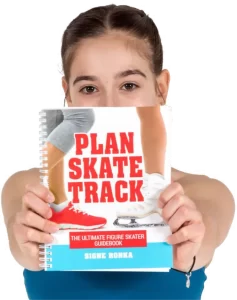
DIGITAL version of the guidebook (price in USD)
Most common injuries in skaters and ways to prevent them
There are many types of injuries that can happen to figure skaters. Sometimes they are accidental, for example falling hard and getting a bone bruise, or they can be stress/impact related, which means repetitive pounding movements causing injury.
In my years of experience, the most common injuries I see regularly are: jumpers knee, ankle related injuries (stress fractures, strains etc), shin pain, back pain, and hip pain.
One of the most important things I try to teach and educate the skaters about is always thinking about training both sides of the body equally. For example, skaters are on average more quad muscle dominant, which means things like knee and hip pain can onset a lot quicker. It’s critical to train the back leg muscles too (hamstrings, gluttes) to have balance not only for strength for skating but injury prevention.
We have a whole program built around injury prevention, which incorporates isometric training, balance, stability of the joints, isolation drills and resistance band work to focus on body control.
Tips to stay safe while doing off ice jumps
This is a critical aspect to training for all skaters. The first thing to consider is proper equipment, meaning running shoes, proper flooring for jumping (not concrete) and enough space to move around safely.
Technique & Alignment of course is critical to making sure jumps are safe. Usually if a skater is falling off ice more than 3-4 times in a row on the same exercise, you should stop them and look at fixing some technical/alignment errors. Skaters should not be falling in off ice jumps often if the proper progressions are in place, off ice should be a place where skaters build confidence on their jumps with more controlled positions.
My saying is always: “More drills to improve your skills”! This means, skaters should spend on average 80% of their time working on exercises and perfecting movement patterns and 20% of trying the jumps across the floor. The more your body can engage the nervous system to fire the muscles in the right order, the quicker you will see improvement on the jumps. There are times where I teach a 45 min private lesson and we spend 30 min on breaking down movements, alignment, ankle control exercises, etc and then the last 15 min we do video analysis on the jumps.
I strongly believe that off-ice jumping should be a safe, learning nervous system training experience rather than a repetition focused workout. Why? Well skaters are already pounding so much on the ice on the jumps. I’m not saying don’t put in your reps for jumps off ice too, but be smart about how many attempts you do of each jump. Ask yourself “why am I trying 5 more double axels”? If you have a key focus you spent time working on fixing, it makes sense to try to see and analyze if there is improvement on each rep. If you are just doing 5 more double axels because you need to get 20 done today, maybe think again what you are trying to accomplish with each repetition. Make the repetitions count!
Ankle/Mobility strengthening exercises
Best tools to enhance off ice training and recovery aids
Whenever I start with a skater, I always ask “do you have resistance bands”? This is probably the number one tool we use in our program for everything. You can do so much with resistance bands not only for strength, but jumps, flexibility, conditioning, and of course injury prevention. I attached a link to our bands:
For recovery, anything from a tennis ball to a foam roller is a great tool to use to roll out the muscles after a workout. This is the closest to a massage therapist you can get to dive deeper into the muscles to relax them.
The other more investment type of tool would be a soft plyometric box, you can use at home to work on strength and power. Remember, if you do any plyometrics on your own at home, be sure to have proper technique training AND know which height of the box you should be jumping on. Oftentimes, skaters see a box and jump up and on without thinking about technique. This is very dangerous! Make sure when doing it on your own, you have proper progressions and a trainer is regularly checking in to teach and focus on good landings. Our plyometrics classes teach skaters the essential skills to be set up for at home training.
_____________________________________